
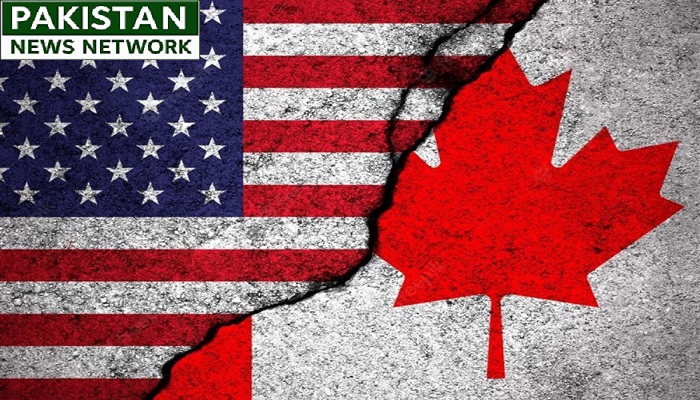
PNN – Donald Trump has once again escalated trade tensions between Washington and Ottawa by announcing heavy tariffs on certain Canadian goods—a move that drew a reaction from Canadian officials.
According to the report of Pakistan News Network; On Monday, U.S. President Donald Trump announced sweeping tariffs against Canada that could reignite a trade war between the United States and one of its closest allies and largest economic partners.
The 50 percent tariff on certain Canadian goods—including electrical equipment and machinery—ranks among the steepest tariffs the Trump administration has ever imposed on a single country.
Although Trump had recently threatened to impose tariffs on Canada in response to smoke from Canadian wildfires drifting into the northern United States, U.S. administration officials stated that the new tariffs are unrelated to that issue. The White House announced that the tariffs would take effect in 30 days and cover approximately $20 billion worth of Canadian goods.
Canadian Prime Minister Mark Carney said in a statement on Monday: Canada believes in the benefits of free and fair trade.
He added that Canada would take whatever measures necessary—under any circumstances—to strengthen its domestic economy and support Canadian workers, farmers, businesses, and families.
However, Ontario Premier Doug Ford took a tougher stance, immediately calling for retaliatory action.
In a post on X, he wrote: If these tariffs are implemented, Canada must respond dollar-for-dollar and tariff-for-tariff.
To justify this move, Trump invoked Section 338 of the Tariff Act of 1930—a law authorizing the president to impose tariffs of up to 50 percent if a country discriminates against U.S. goods. However, this statute had never previously been applied in this manner.
Several key imports from Canada have been exempted from this new round of tariffs, including energy products, strategic minerals, and fish, as well as goods such as automobiles and metals that were already subject to sectoral tariffs.
However, unlike Trump’s previous tariffs against Canada, this time no exemptions have been granted for goods covered by the US-Mexico-Canada trade agreement—an agreement currently undergoing renegotiation.