
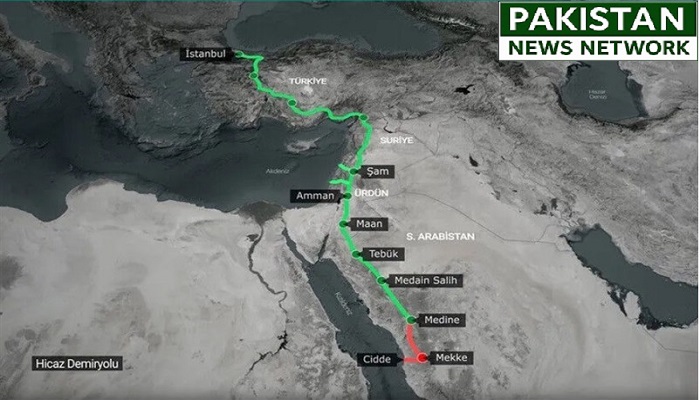
PNN – Turkey is pinning high hopes on the revival of the Hejaz Railway, yet it faces several major challenges.
According to the report of Pakistan News Network; the concept of “connectivity” is frequently highlighted these days within Turkey’s political and economic circles.
Turkish analysts believe that despite being mired in an unprecedented and historic economic crisis, the country can resolve its difficulties by leveraging its geographical advantages and connectivity. In discussions regarding the importance of transit routes and corridors, they also view the revival of the Hejaz Railway as a strategic objective.
On June 9 of this year, Turkey and Saudi Arabia signed a memorandum of understanding that, according to economic analysts in Ankara, could transform regional trade dynamics. However, the benefits and significance of this agreement will only be realized if similar agreements between Turkey, Syria, and Jordan also come to fruition—a process contingent upon a shared political will to pursue regional connectivity and integration projects centered on the historic Hejaz Railway.

Ankara views the Hejaz Railway project as a strategic initiative where regional stability and national interests converge. In this regard, the project is seen as a complementary tool for developing transport and logistics infrastructure and bolstering regional security by deepening economic integration.
At the same time, Saudi Arabia’s integration into the Hejaz Railway project represents a significant step for Syria. The project—which will extend from Turkey through Syria and Jordan to Saudi Arabia—is considered a strategic infrastructure investment that supports the economic dimension of Riyadh’s policy regarding Syria.
This railway is also of strategic importance for Saudi Arabia’s food security. Due to its geographical and climatic conditions, the country relies on foreign sources for its food supply and has recently increased its investments in Syria’s agricultural sector.
Reactivating the railway provides the necessary logistical infrastructure for these investments and facilitates the faster, more cost-effective, and safer transport of agricultural products.
Similarly, initiatives regarding digital connectivity highlight Syria’s growing strategic importance to Saudi Arabia. The SilkLink project, which envisions routing internet data cables through Syria, demonstrates that transport and digital infrastructure are being considered in tandem, with the aim of positioning Syria at the heart of regional connectivity networks.
Turkey’s Excessive Optimism
A review of content and reports from certain think tanks, news outlets, and newspapers close to the AK Party reveals that the Erdoğan administration and the country’s ruling party hold an optimistic view regarding the revival of the Hejaz Railway.
Hossein Bahri Kurt, an analyst affiliated with think tanks close to the Erdoğan administration, writes: Coinciding with regional developments and the targeting of Saudi Aramco facilities on March 2, Riyadh’s perception of the threat intensified significantly. This shift prompted Saudi Arabia to adopt more deterrence-oriented rhetoric, and it was publicly reported that the Kingdom carried out limited retaliatory strikes following the attacks. However, Saudi Arabia possesses limited military and diplomatic tools. Consequently, Riyadh, alongside other Persian Gulf states, is striving to rebuild regional security not merely through military deterrence, but through initiatives that foster political cooperation and regional integration. For the Gulf States—which have long borne the security costs of the rivalry between Israel and Iran—cooperation with Turkey, a proponent of crisis management grounded in diplomacy, dialogue, and regional ownership, constitutes a crucial pillar of this strategy.
Continuing, this Turkish analyst highlights the importance of the Hejaz Railway project—viewed both as a transport investment and as a tangible instrument in the pursuit of a new regional order—and writes: The political and economic rapprochement fostered by this project between Ankara and Riyadh will yield consequences across numerous sectors, ranging from security and trade to energy, logistics, and infrastructure. This strategy—grounded in diversifying relations with regional actors and expanding various partnerships through connectivity projects like the Hejaz Railway—is assuming a more institutional and enduring character. The agreement on the Hejaz Railway project can be viewed as a significant step that complements the economic and logistical dimensions of the strategic partnership between Turkey and Saudi Arabia—a partnership that has been rapidly deepening in recent years. Relations between the two nations have not been limited to trade and investment; they have also begun to establish an institutional framework spanning the fields of defense, security, and diplomacy.

Hüseyin Bahri Kurt views the Hejaz Railway connection as a continuation of the strategic mutual security agreement signed between Saudi Arabia and Pakistan in September 2026, as well as a reflection of Ankara’s desire to play an active role in the emerging regional security architecture. He believes that the Hejaz Railway project strengthens the logistical infrastructure for multifaceted cooperation and supports the transport network essential for trade and economic collaboration, particularly within the defense industry. In this regard, the Hejaz Railway is not merely a symbolic indicator of the existing closeness between the two nations; it stands out as a complementary element that elevates strategic cooperation to a more institutionalized and sustainable foundation. In this context, Saudi Arabia securing an uninterrupted overland connection to Turkish and European markets via the Hejaz Railway is of strategic importance. While the railway may not entirely eliminate reliance on the Strait of Hormuz and the Bab al-Mandab Strait, it establishes an alternative transport corridor and enhances supply chain resilience. Consequently, connectivity projects will contribute not only to economic integration but also to the creation of a supply security architecture that is resilient and diversified in the face of regional crises.
Furthermore, according to Sabah—a newspaper affiliated with Turkey’s ruling party—the Hejaz Railway project represents more than just the revival of a historic transport route for Saudi Arabia. The project brings together multiple strategic objectives, including supporting stability in Syria, bolstering regional security, diversifying supply chains, deepening the strategic partnership with Turkey, and advancing the goals of Vision 2030. In this context, the Hejaz Railway demonstrates that regional connectivity has evolved into a strategic tool—not only in economic terms but also regarding security and foreign policy.
What Turkey Fails to See
According to experts in the field of strategic studies regarding economic corridors, media outlets aligned with Turkey’s ruling party—in their reports on the significance of the Hejaz Railway—fail to distinguish between a “potential corridor” and an “actual,” ready-to-use corridor. What currently exists is a collection of vastly different national rail networks across Turkey, Syria, Jordan, and Saudi Arabia; these must be integrated into a unified system by addressing various parameters—such as infrastructure, track gauge, technical standards, customs, security, investment, border management, insurance, tariffs, transit times, and cargo capacity—and, most importantly, by ensuring political stability.
According to an analyst from the Turkish website Focus, contrary to the claims of Erdogan’s government officials, what currently exists is not a ready-made line from Istanbul to Mecca, but rather a collection of national networks and varying political conditions that might eventually evolve into a connected corridor.
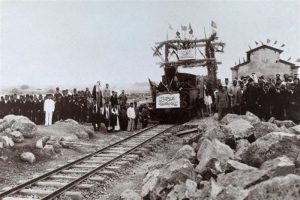
Analysts at the Foundation for Defense of Democracies have noted that reviving the Hejaz Railway—connecting Saudi Arabia to Turkey, Syria, and Jordan—is geopolitically significant. However, its realization is by no means imminent or certain.
They highlight three major challenges: First, financing difficulties: it remains unclear who will bear the cost of constructing and rehabilitating this multi-country corridor. Second, Syria: a crucial segment of the route passes through Syria—a nation still grappling with state stabilization, security, reconstruction, and territorial control. Third, corridor governance: it is unclear who will manage the system and what standards will apply to customs and transportation.
Furthermore, the question of who will guarantee the security of the line—and what would happen to the entire corridor should political instability arise in any of the four involved countries—remains unresolved.
Another significant issue is that certain U.S. political and security bodies view the proposed Saudi-Turkish-Syrian-Jordanian rail link as an anti-Israeli project; true to form, they are concerned about potential harm to the Zionist regime.
This is not merely a matter of security threats; it also involves the creation of a tangible rival to the India-Middle East-Europe Economic Corridor (IMEC)—the very route that has been the subject of repeated discussions among India, the UAE, Saudi Arabia, Jordan, the European Union, and the Zionist regime.
Of course, not all American think tanks share the same view on this matter; for instance, the Atlantic Council suggests that a network of corridors could serve as a hedge against disruptions in the Middle East’s strategic straits.
An analysis by the Gulf Institute also notes that, contrary to claims, the Hejaz Railway cannot serve as a lever to alleviate pressures on the maritime route leading to the Strait of Hormuz.