
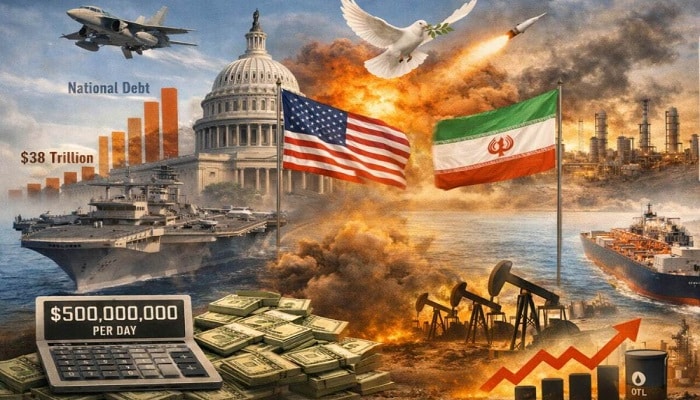
PNN – Two months into the US war against Iran, the true dimensions of the costs have become clearer; from billions of dollars in daily costs to trillions in debt, the financial strain of the war is beyond expectations.
According to the report of Pakistan News Network; Two months into the US war against Iran, a clearer picture of the true costs of the conflict is now available, revealing a significant gap between initial estimates and the realities on the ground. Contrary to initial predictions that emphasized a short, low-cost war, the available data shows that costs have escalated rapidly, reaching levels far higher than expected.
According to published information, the direct costs of the war are estimated at an average of about $2 billion per day. This figure only includes the obvious costs such as military operations, fuel, troop movements, and logistical support. In the early days of the war, the initial estimate was $11.3 billion, but this figure quickly rose to at least $16 billion, a clear indication of a computational error in the initial estimates.
One of the most important factors in increasing costs is the maintenance of heavy military equipment. For example, an aircraft carrier costs about $300,000 per day to maintain. This figure is only for maintaining operational readiness and does not include actual operating costs; given the presence of several ships and similar equipment in the region, the total of these costs increases exponentially.
In addition, there is a significant gap between actual costs and what is recorded in official reports. This “operational and accounting gap” includes costs such as ongoing repairs, equipment depreciation, technical support, and long-term deployment of troops, which are often not fully reflected in the statistics.
Another key factor is the rising cost of replacing military equipment. Many assets are recorded in financial systems at old prices, but now cost up to twice as much to replace. For example, a fighter jet that used to cost about $38 million now costs about $70 million to replace. Tomahawk missiles, which used to cost about $3.5 million, are now in the $4 million to $5 million range. Defense systems like the Patriot also cost in the multi-million dollar range.
On the other hand, the “cost asymmetry” has become a serious challenge. In this context, a drone costing about $30,000 can pose a threat that can be countered by a missile worth about $4 million. This significant difference makes even limited conflicts very costly.
In the long term, the costs of war are even greater. The debt owed to veterans has reached an estimated $7.3 trillion, and about 37 percent of them are on disability benefits. This alone will put a continuing financial strain on government budgets for years to come.
Moreover, the war is financed by an increase in the national debt. Currently, about 15 percent of the entire federal budget is spent on interest payments on the debt. This shows that the cost of war is not limited to the battlefield, but is spread throughout the economy through the country’s financial structure.
Overall, combining daily direct costs, equipment maintenance, replacement cost increases, cost asymmetries, and long-term obligations such as veterans’ pay and debt interest, suggests that the true cost of this war could be as high as $1 trillion. Not only would this create significant economic strain, but its consequences would also last for generations to come.