
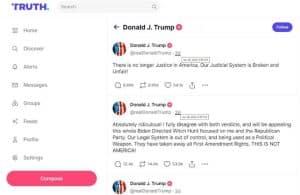
PNN – Trump’s controversial posts on Truth Social are not merely spontaneous reactions; behind this activity lies a mechanism that generates and amplifies these messages, transforming them into political narratives.
It has been about a year and eight months since the start of Donald Trump’s second presidential term, and his Truth Social page has become one of the most high-traffic communication channels for a U.S. president—a platform where threats, political attacks, reposts, images, news-style claims, and even foreign policy statements are published in rapid succession.
This volume of messaging—particularly when a theme is repeated incessantly—raises the question: are we witnessing Trump’s spur-of-the-moment reactions, or a mechanism designed to generate and cement political narratives?
Recent reports by U.S. media outlets have shed light on aspects of this mechanism—ranging from the role of aides like Natalie Harp in curating and relaying suggested content, to the network of accounts aligned with the “MAGA” movement that fuel this messaging machine.
At the same time, an analysis of thousands of Trump’s posts reveals that the repetition of specific themes—ranging from elections and political opponents to aggression against Iran—has become a consistent pattern in his communications; a pattern that conveys messages not only to his domestic supporters but can simultaneously influence the media, markets, foreign governments, and parties in conflict with the United States.
Does Trump actually generate these narratives himself?
The picture that emerges from Donald Trump’s extensive activity on Truth Social is not limited merely to the posting of personal messages by the president.
In June 2025, The Washington Post reported—after analyzing 2,262 of Trump’s posts from his first 132 days in office—that the president relies on a small team for his media activities. According to the report, Trump frequently dictates the text of his posts to his aide, Natalie Harp; furthermore, camera crews filming a documentary about his campaign had previously captured footage of Trump dictating posts while Harp and Dan Scavino typed them out.
Published reports regarding Harp indicate that this Trump aide has earned the nickname “human printer” within White House circles, owing to the fact that he carries a small printer and delivers printed copies of news and preferred content to the President. Reports by The New York Times also identify him as a member of Trump’s inner circle, highlighting his role as a conduit for conveying information and content to the President.

The same report also highlights another important point: Trump does not always post through aides but sometimes publishes content himself—particularly late at night or in the early morning hours while watching television news.
A senior White House official also told The Washington Post that the President relies on a small team to manage his online activity, with Dan Scavino handling the bulk of his social media presence.
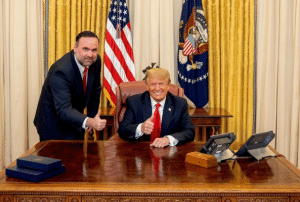
Therefore, what appears on Trump’s page is a combination of his personal messages and a process in which his aides play a role in preparing and transmitting the content.
However, a more significant fact lies beyond the specific roles played by Harp and Scavino. In that same analysis, The Washington Post demonstrated that once Trump’s posts appear on Truth Social, they are rapidly reshared by figures within the “MAGA” movement and allied media outlets, thereby reaching a vastly larger audience. Citing social media researchers, the newspaper noted that despite having a much smaller audience than X, Truth Social has effectively become a source that fuels pro-Trump movements—a platform from which content migrates to other networks and is amplified.
Consequently, based on these American reports, it can be said that what unfolds on Truth Social is not merely a direct interaction between Trump and his audience; rather, a chain of content creation, transmission, dissemination, and resharing has formed around the president.
According to analysts, when a message issued by the president is amplified by a network of aligned accounts and media outlets—and subsequently re-enters the news cycle—a single personal post can rapidly evolve into the dominant narrative surrounding a given issue. The power of this mechanism lies not merely in the volume of Trump’s posts, but in its capacity to transform brief messages into media and political agendas.
A barrage of messages regarding Iran; is the repetition of Trump’s posts coincidental?
An analysis of Trump’s behavior on Truth Social reveals that the repetition of specific messages and topics has become an integral part of his communication style. The Washington Post, which examined 2,262 of Trump’s posts over the first 132 days of his second term, concluded that his activity volume on the platform was more than three times that of the corresponding period during his first term.
This pattern is not limited to domestic issues; it is also evident in foreign policy. In an analysis of Trump’s activity during the period surrounding the incursion into Iranian territory late last winter, The Washington Post reported that of the 222 posts he made between the onset of the attacks and the days that followed, fewer than one-fifth directly addressed Iran—even as the President continued to post simultaneously about political opponents, elections, sports, the media, and domestic matters.
This data indicates that even amidst a military conflict, Trump does not abandon his customary communication style and continues to pursue multiple narratives in parallel.
A clearer example of this pattern can be seen in the volume of messages concerning Iran. An analysis published in August 2026 reveals that between February 28 and August 25, 2026, Trump published at least 4,190 posts on Truth Social—319 of which directly related to Iran—amounting to roughly one post about Iran every 14 hours.
The significance of these figures lies in the fact that Trump does not merely take a stance on Iran and move on; rather, he constantly redefines the issue with fresh claims. Military threats, ultimatums regarding the Strait of Hormuz, assertions about destroying Iran’s nuclear capabilities, declarations of victory, promises of negotiation, and subsequent reversions to economic pressure have repeatedly appeared side-by-side in his messaging.
Thus, while the specific aspects of the Iran issue addressed in his messages have shifted, the subject of Iran itself has remained a constant feature of his communication. Synthesizing this data reveals a crucial insight: the function of repetition in Trump’s messaging is not necessarily to convey new information, but rather to keep the topic alive within the news and political cycles.
A political claim, threat, or attack is first launched on the President’s page, then amplified by a network of supporters and aligned media outlets; ultimately, the reactions from opponents and critical media feed that same message back into the news cycle.
In this way, even a brief message can reach the audience repeatedly and in various formats—a pattern that appears to have transformed Truth Social from a personal social network into a key link in the production and repetition of Trump’s political narrative.
Experts believe that while Trump can keep Iran at the center of media and political attention by constantly repeating a narrative, he cannot turn his proclaimed outcome into reality merely by reiterating a claim. The oil market’s diminishing reaction to Trump’s stances exemplifies this waning impact, demonstrating that audiences, governments, and markets distinguish between repeated messages and their actual consequences.