
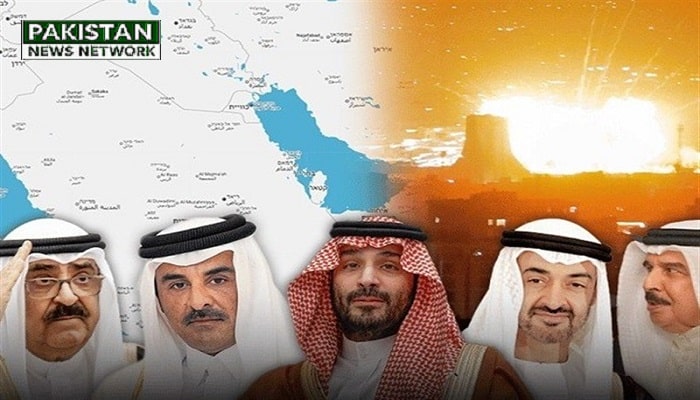
PNN – The New York Times reported that Arab nations, realizing they are not a U.S. priority, are seeking a new security umbrella.
According to the report of Pakistan News Network; the recent regional conflict—sparked in late February by U.S. and Zionist regime aggression against Iran and resulting in a crushing response from our country—has had far-reaching consequences for both the region and the world. This conflict has led Persian Gulf states to recognize a massive gap and flaw in their security architecture, which had relied entirely on the United States.
In this context, Arab sources have reported that over the past few months, certain Persian Gulf states have been considering new arrangements to safeguard their security and are attempting to open channels for direct dialogue with Iran regarding issues such as navigation in the Strait of Hormuz.
Conflict with Iran Exposed the Vulnerability of Persian Gulf States
In a report on this matter, the American newspaper The New York Times stated that while Persian Gulf states have long relied on U.S. security guarantees, more than six months of repeated missile and drone attacks by Iran have clearly exposed the shortcomings of those guarantees.
The New York Times added that some U.S. bases in Persian Gulf countries have been virtually destroyed in Iranian attacks, and, furthermore, energy infrastructure in these nations—including Saudi Arabia—has sustained significant damage. Against this backdrop, officials in Persian Gulf states are now seeking alternative ways to ensure their security, including resorting to direct diplomacy with Iran.
Citing analysts, this American media outlet reported that regional leaders have no choice but to seek alternative security arrangements, as the conflict involving the U.S., Israel, and Iran has exposed the vulnerabilities of Gulf States and increased Iran’s influence.
Bader Al-Saif, a history professor at Kuwait University, told The New York Times regarding the situation of the region’s nations: We are caught at a point where we are trying to build something new while preserving part of the past. We need to break free from this obsession with external protection.
Exposing the Hollow Nature of the US Security Umbrella for Gulf States in a Regional Conflict
Citing Bahrain as an example of the Persian Gulf states’ reliance on the US security umbrella, The New York Times highlighted that Bahrain had hosted the largest US naval base for decades in the hope that it would provide protection; however, the base—like other US facilities in the region—became a target of repeated Iranian attacks and was virtually destroyed.
The newspaper reported, citing an unnamed US military official, that most of the sailors stationed at the base have been transferred to Florida, leaving behind only a small crew.
The Strategic Defeat of the US and Gulf States by Iran
The report further notes that this war has inflicted heavy losses on the US and its regional allies; Iran’s effective closure of the Strait of Hormuz represents a major strategic defeat and an economic setback for energy exporters in the Persian Gulf states.
The New York Times emphasized that the US military’s inability to repel Iranian attacks signifies another strategic failure, one that could have serious consequences for Persian Gulf nations and for the United States’ ability to project power.
The aforementioned American media outlet added that, despite this, Bahrain and other Persian Gulf states—including Saudi Arabia, the United Arab Emirates, and Kuwait—lack a single, unified alternative to serve as a guarantor of their security.
The report further emphasizes that while Persian Gulf nations have spent billions of dollars on advanced weaponry, their militaries remain smaller and weaker than Iran’s; meanwhile, China and Russia have offered them no assistance, despite their close ties to the region.
According to the report, efforts by Gulf states to secure alternative security routes and achieve greater defense self-sufficiency remain in the experimental stage, as agreements aimed at bolstering regional security—such as the new defense pact between Saudi Arabia and Pakistan—have yet to be tested.
Gulf States have realized they are not a top priority for the United States.
The New York Times emphasized that it remains unclear whether any of these nations would be willing or able to provide assistance to the Gulf States. Consequently, the most realistic option for Gulf nations is to forge defense partnerships that complement the U.S. security umbrella but do not replace it.
The American media outlet noted that Iran’s attacks have harmed the economies of the oil-rich Persian Gulf states and tarnished their image as safe havens in a turbulent region. Furthermore, the conflict demonstrated that the advanced defense systems of Gulf nations are not necessarily always resilient, and that Iran is capable of inflicting heavy losses on these countries using large numbers of relatively inexpensive drones.
Citing Kristian Alexander—a senior fellow at the Rabdan Security and Defence Institute, a UAE government research body—the newspaper reported that the United States prioritized protecting its own forces and Israel in the face of intense retaliatory attacks by Iran, and that these priorities did not align with the Gulf states’ need to protect their airports, ports, and desalination plants.
The New York Times also reported that a shortage of U.S. interceptor missiles during the early weeks of the war posed a significant challenge for Gulf States, prompting them to seek assistance from Ukraine and other European nations. Nevertheless, these countries still failed to mount an adequate defense against Iranian attacks.