
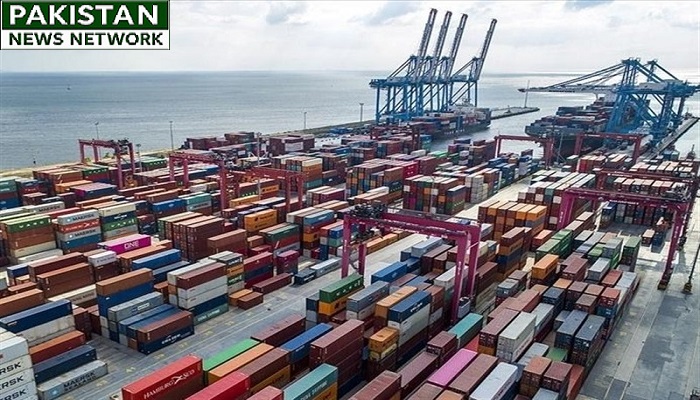
PNN – After suffering a significant declining in the home appliance sector, Turkey has also lost a substantial share of the clothing market.
According to the report of Pakistan News Network; amidst the ongoing economic crisis in Turkey and rising debt across both public and private sectors, the need to secure foreign currency has become increasingly critical; consequently, the Erdoğan administration aims to boost the volume and value of goods exports. However, not only has there been no major success in this area, but serious problems have also emerged in two specific sectors.
The latest export market data reveals that, following a significant setback in the home appliance sector, Turkey has also lost a substantial share of the clothing market; meanwhile, it faced declining sales in Europe—a region where countries such as Tunisia, Morocco, Bangladesh, and Vietnam recorded higher sales figures, demonstrating that they are formidable competitors to Turkey’s clothing industry.

New data from the R&D department of the Istanbul Ready-to-Wear and Apparel Exporters’ Association (İHKİB) indicates a significant decline in Turkish clothing exports to European Union countries during the first five months of 2026.
While Turkey has lost a substantial portion of its revenue from clothing exports to Europe due to competitive pressures driven by high costs, it remains the European Union’s third-largest supplier.
Eurostat data indicates that Turkey’s clothing exports to the European Union have dropped by 16 percent, falling from €4 billion to €3.4 billion. Despite this performance, Turkey has retained its position as the third-largest supplier of ready-made garments to the EU—trailing behind China and Bangladesh—though it lags significantly behind both; China exports €12 billion worth of clothing to the EU, and Bangladesh nearly €8 billion. Meanwhile, other competitors such as Vietnam, Morocco, and Tunisia are steadily gaining ground, leaving no guarantee that Turkey will be able to hold onto the third spot next year.
Yener Karadeniz, an economic columnist for the news outlet Ekonomim, writes that Turkey’s share of ready-to-wear clothing exports to the European Union has gradually declined over the past two years; concurrently, several major Turkish clothing retailers in Russia have been forced to close branches due to falling sales.
The Turkish economic analyst believes that while the quality of Turkish-made clothing has not deteriorated during this period, high production costs have kept prices at a level that cannot compete with the relatively inexpensive garments from China, Bangladesh, Vietnam, and other nations.

The Value-Added Challenge
Statistics indicate that Turkey faces a challenge regarding value-added in its garment industry; on average, it earns only €20.04 per kilogram of clothing exported to European Union countries. While this average revenue has remained unchanged over the past two years, production costs have risen significantly, meaning exporters are effectively realizing very little profit.
In contrast, garments from Morocco and Tunisia—produced at lower costs—have commanded higher prices, averaging €25 and €23 per kilogram, respectively. Meanwhile, in the textiles and raw materials sector, purchases from Turkey have declined by 9.8 percent, falling to €1.3 billion.
What is the core issue?
Many Turkish economic analysts point to high production costs as a major obstacle to the growth of goods exports in Turkey. However, the problem goes beyond that; there are also significant flaws in policymaking. In certain export sectors, for instance, overly optimistic and erroneous forecasts regarding the capture of target markets proved wrong within just four years. The home appliance manufacturing and export sector is one such area.
According to TÜRKBESD data for the first half of the current year, Turkey’s home appliance exports have fallen by 19 percent, while production has declined by 15 percent.
A Bloomberg report notes that export volumes fell by 23% in the first quarter of this year, with shipments of refrigerators, washing machines, and dishwashers declining by 32%, 31%, and 22%, respectively.
Turkey’s apparel and home appliance sectors share a common trait: both rely on an outdated competitive model characterized by mass production, low-cost labor, established supply chains, and geographical proximity to Europe.
However, this model is now viewed as a roadmap incapable of adapting to new developments; it is being undermined by rising labor costs and yields low value-added.
Currently, Turkey’s revenue from goods exports to global markets relies heavily on two sectors: automotive and chemicals. Automotive export revenue (including output from Japanese and Korean assembly plants) stands at $37 billion, while chemical exports amount to $31 billion; meanwhile, the apparel sector—which was expected to surpass $20 billion—is now effectively in decline.
There are several other export sectors performing satisfactorily, yet concerns remain regarding their future trajectory due to their reliance on raw materials and production costs.
For instance, while steel sector exports stand at around $16 billion, profit margins are low; in contrast, the electrical and electronics sector—with $17 billion in exports—fares better.
In the machinery sector, Turkey has a total export capacity of $11.2 billion, yet penetrating new markets is essential to increase this figure.
Economic experts believe that for at least three decades, Turkey’s export focus has primarily been on apparel, textiles, footwear, home appliances, furniture, steel, and medium-tech products. However, it now needs to shift its focus toward the automotive sector, machinery, electrical and electronic goods, the defense industry, aerospace, industrial equipment, specialty chemicals, energy equipment, and technical and engineering services.