
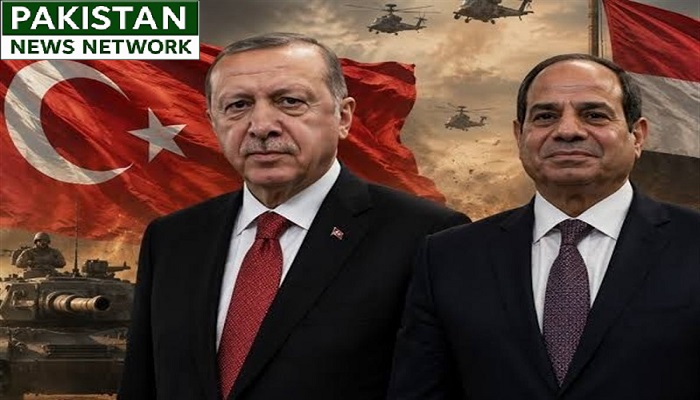
PNN – Over a span of 13 years, Türkiye and Egypt have moved from a state of severe tension toward the normalization of relations.
According to the report of Pakistan News Network; the initiation of cooperation in the defense industry between Turkey and Egypt is a significant development that has drawn the attention of regional political analysts. Following the signing of a military framework agreement in February, Turkey and Egypt signed two additional documents on July 13, aimed at fostering military cooperation as well as collaboration within the defense industry.
Until just a few years ago, Erdoğan—in all his public rallies—characterized Abdel Fattah el-Sisi as a murderer, a coup plotter, and a dictator; during the Istanbul municipal elections, he even argued that voting for İmamoğlu was tantamount to voting for el-Sisi.
However, those tensions have now subsided; over the course of thirteen years, Ankara and Cairo have moved from acute friction toward the normalization of relations and have now entered a phase of defense cooperation.
Turkey and Egypt conducted a joint air exercise for the first time this year and are now moving toward cooperation in the defense industry. These developments coincide with an emerging coalition among Turkey, Egypt, Pakistan, and Saudi Arabia that also encompasses security cooperation.

Turkish Defense Minister General Yaşar Güler and his Egyptian counterpart, General Ashraf Salem Zaher, emphasized yesterday that military cooperation has gained significant momentum following recent high-level reciprocal visits.
In a statement, the Turkish Ministry of Defense announced: To strengthen dialogue on defense and security, the scope of cooperation has expanded through reciprocal contacts between military delegations, and concrete steps have been taken in the areas of military training, joint activities, and the defense industry.
Egyptian Defense Minister General Ashraf Salem Zaher has also stated that the meeting with Selçuk Bayraktar—owner of the drone manufacturer Baykar—and Haluk Görgün, head of Turkey’s Defense Industry Agency, demonstrates the serious determination of both Cairo and Ankara to collaborate directly on the development of defense industries.
Görgün added: I believe that expanded cooperation between Turkey and Egypt in the defense industry sector will contribute to regional security and mutual capacity building.
Cooperation in the defense industry sector between the two countries was discussed extensively—particularly during Turkish President Recep Tayyip Erdoğan’s visit to Cairo in February—leading to significant agreements between the Egyptian armed forces and Turkish defense companies, including a $350 million contract signed between the Machinery and Chemical Industry Corporation (MKE) and the Egyptian Ministry of Defense. Furthermore, Aselsan, a renowned Turkish defense brand, established a representative office in Egypt in late 2025.
Experts state that negotiations have focused primarily on products such as unmanned systems, armored vehicles, warships, ammunition production, and electronic warfare systems. Cooperation with Turkey is expected to entail joint production, technology transfer, and joint investments in Egypt.

The defense agreement between Turkey and Egypt has drawn the attention of media in both Ankara and Cairo, and regional analysts view it as significant.
Turkish defense media have emphasized that the objective is not merely the sale of equipment, but rather the establishment of a cooperation framework for the joint development of defense capabilities, production, and the management of industrial projects.
Meanwhile, Egyptian media and official bodies have described these agreements as part of a long-term roadmap for military cooperation and the exchange of expertise between the two countries’ armed forces.
An Al-Monitor analytical report notes that the new defense cooperation is part of Turkey’s broader strategy to redefine its position in the Eastern Mediterranean and counterbalance the Greece-Cyprus-Israel axis.
Meanwhile, Greek media outlets believe that Ankara and Cairo have concluded that shared economic and security interests outweigh past disputes, and they view Egypt’s potential participation in major Turkish defense projects—including the KAAN fifth-generation fighter jet program—as significant.
Geopolitical Implications
Given the intertwined interests of regional actors, the industrial agreement and cooperation between Ankara and Cairo can be viewed as a project that—beyond its impact on Israel and Greece—also influences developments concerning Libya, North Africa, and certain Arab states of the Persian Gulf.
Although the military rapprochement between Egypt and Turkey complicates the security dynamics of the Eastern Mediterranean, past experiences and the foreign policy styles of both Erdoğan and Sisi suggest that this cooperation cannot yet be characterized as an anti-Israeli alliance.
Meanwhile, Greece—a country that faces tensions with Turkey in the Eastern Mediterranean while cooperating with the Zionist regime—is closely monitoring the recent agreement between Ankara and Cairo. Increased cooperation between Egypt and Turkey could enhance the prospects of managing the rivalry between the two nations regarding the Libya issue; at the same time, Gulf States are also affected, with the UAE and Saudi Arabia welcoming the de-escalation of tensions between these two major regional powers.
Over the past few years, Türkiye has established embassies in 48 African capitals, and it can now gain broader access to African markets and defense cooperation through Egypt.
Political analysts believe these agreements should not be viewed merely as the signing of routine defense documents. Given the region’s geopolitical shifts following the normalization of Turkey’s relations with the UAE, Saudi Arabia, and Egypt, we are facing a new landscape; this process led to the initiation of a defense agreement between Ankara and Cairo in July 2026 and has now entered a phase of expanded military and defense-industry cooperation.
Consequently, the agreement in question can be viewed as a quiet conclusion to a decade of ideological rivalry between Turkey and Egypt—a period marked by long-standing competition and occasional tension over issues such as the Muslim Brotherhood, Libya, the Eastern Mediterranean, Qatar, and regional influence.
A situation has now emerged in which both sides seek to manage their differences. Furthermore, a new axis is taking shape in the Eastern Mediterranean; in the current climate, Ankara aims to create greater room for maneuver to counter the expanding cooperation between Greece, Cyprus, and Israel, and rapprochement with Cairo serves as one of the tools of this strategy.
Turkey now intends to enter a new phase regarding the export of its defense industry products to Egypt; beyond merely selling drones to Cairo, it aims to pursue industrial partnerships, joint production, and the creation of a regional supply chain, while also defining long-term defense projects.
Undoubtedly, Egypt also has specific interests in this regard, seeking advantages such as diversifying its sources of weaponry, gaining access to new defense technologies, collaborating on military production, and increasing its independence from a reliance on traditional suppliers.
In conclusion, the defense agreement between Turkey and Cairo conveys a significant political message for the region, signaling that the Middle East is entering a period where past rivalries are giving way to pragmatic alliances.