
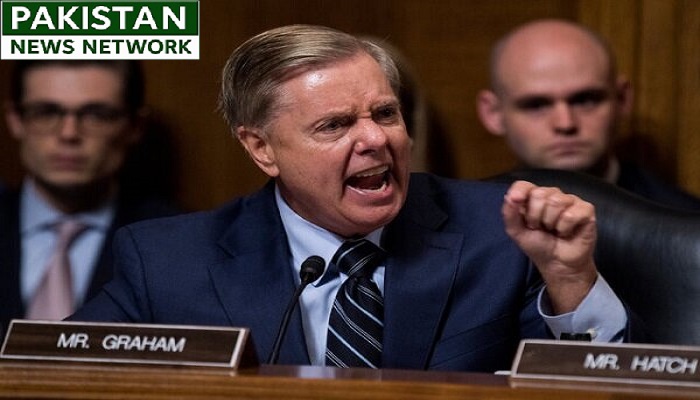
PNN – Following the news of Lindsey Graham’s death, the profound shifts in his political stances and his extremist approaches have led American media to describe him using terms such as “political chameleon” or “symbol of evil.”
According to the report of Pakistan News Network; in the wake of the announcement of Lindsey Graham’s death, American media outlets examined his political background and the drastic changes in his extremist positions, noting that Graham was no ordinary politician but rather one of U.S. President Donald Trump’s closest allies. Trump described Graham as a “dear friend” and “like a member of the family.”
An Instrument of Malice and a Political Chameleon
Most American newspapers have focused on the void left by Graham’s death within the Republican Party and the Trump administration. However, David Rothkopf, a columnist for The Daily Beast, describes Graham—in his analysis of the politician’s career—as a “chameleon” who had mastered the “dance of politics” in Washington.
Rothkopf emphasizes that the praise heaped upon Graham by both Democrats and Republicans reflects a moral crisis within the American political establishment—an institution the author characterizes as a “Washington club of malice.”
The Daily Beast writer argues that Graham was, in fact, a deceitful opportunist who traded his principles for social clout, shifting his stances before the media and voters based on what served his personal interests.
The article contends that Graham paved the way for the spread of malevolence and became an effective instrument for cementing Trump’s policies and legitimizing a figure who has devastated American democracy.
The author describes Graham as possessing a “chameleon-like flexibility,” constantly altering his political positions; he was willing to back any cause—no matter how nefarious or corrupt—to ensure his own political survival.
In this regard, The Daily Beast adds that Graham shifted from being one of Trump’s fiercest critics during the 2016 campaign to one of his most loyal allies after he reached the White House.
Rothkopf enumerates other glaring contradictions in Graham’s stances: supporting Ukraine while subsequently voting against military aid for the country, and condemning the January 6, 2021, attack on the Capitol while refusing to hold Trump fully accountable for it—these are just a few examples of the inconsistencies also highlighted by Politico magazine.
Trump’s Bridge to Lawmakers
This article notes that Graham leveraged his legal expertise and connections within the “Washington establishment” to advance agendas aimed at undermining the rule of law. Because he understood the “rules of the game” so well, he was more dangerous than the outspoken politicians who loathed the governing structure; while smiling and shaking hands with everyone, he was dismantling the pillars of democracy.
A report by the American magazine Politico highlights that Donald Trump relied on him to contain Republican dissent and secure support in the Senate.
Citing a high-ranking Republican advisor, the report states: In his defense of Trump, Lindsey spoke with a mastery and fluency unparalleled among members of the Senate.
The magazine describes Graham as a man who managed to bridge the gap between his closeness to Trump, his extensive ties with Democrats, and his ability to negotiate with various parties—possessing qualities that made him a vital link between the White House and the Senate.
In a report titled “Trump Has Lost His Right-Hand Man,” The Atlantic also noted that his absence threatens the progress of several White House priorities, as he was the most capable mediator for managing the relationship between Trump and Congress.
A staunch friend of the Zionist regime
While support for Tel Aviv in the United States—among both Republicans and Democrats—has noticeably waned in the wake of the Gaza war, Graham remained an unwavering supporter of the Zionist regime’s policies and atrocities in Gaza, Lebanon, Iran, and beyond. The New York Times noted that these stances bolstered his standing in Israel as one of the most powerful champions of the U.S.-Israel alliance.
The newspaper’s report indicates that Graham’s positions ran counter to the mainstream of his own Republican Party—which leaned toward isolationism and skepticism regarding global interventions—a stance that had earned him widespread popularity within the Zionist regime.
Citing the condolence message from Benjamin Netanyahu, the Prime Minister of the Zionist regime, the newspaper noted that he had described Graham as a “great friend of Israel.” According to the report, Graham played a pivotal role in pushing Washington toward war with Iran and in supporting the normalization of relations between the Zionist regime and countries in the region.
The New York Times and Politico believe that with Graham’s death, Israel has lost a close ally. He was a figure who advanced the Zionist regime’s agenda within Washington’s corridors of power and whispered the regime’s concerns and plans into Trump’s ear.
In May 2024, Graham called for the nuclear bombing of Gaza, stating that Tel Aviv should be equipped with the necessary “nuclear” bombs to end the war there, arguing that “Israel cannot afford the casualties.”
Pointing to the praise heaped upon Graham and his character by the extremist Zionist minister Itamar Ben-Gwer, Rotkopf described Ben-Gvir as a “real monster” and an “unprincipled man,” noting that such praise from extremist and corrupt figures like Ben-Gvir and Trump serves as a testament to Graham’s true character.
Republicans after Graham’s Death
Graham’s death triggered an early contest within the Republican Party to select a successor for his South Carolina Senate seat; Republicans now face the challenge of choosing a party nominee for the upcoming election. Many American publications believe that Graham was a figure who was difficult to replace, given the extensive influence he had built over the course of two decades.
These media outlets maintain that Graham was not merely a prominent Republican senator but a key pillar of the party in Washington; they argue that the real challenge facing Republicans lies not just in selecting a successor for his seat, but in finding a figure capable of fulfilling his political role within the party and managing the relationship between the White House and Congress.