
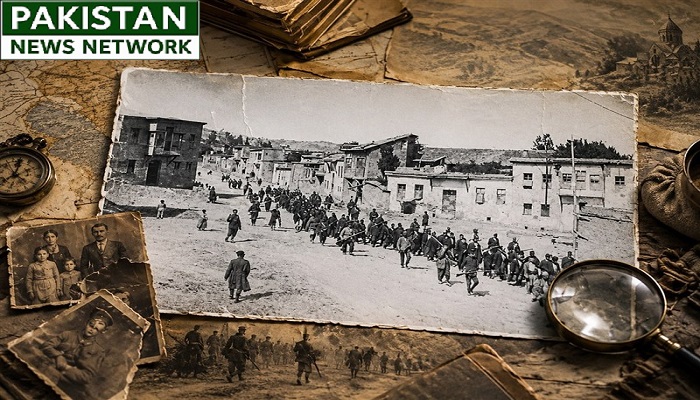
PNN – The recognition of the Armenian Genocide, coinciding with the proceedings regarding the Gaza case in The Hague, has created a serious contradiction for Israel.
According to the report of Pakistan News Network; on June 28, 2026, the Israeli cabinet unanimously approved a proposal by Foreign Minister Gideon Sa’ar to recognize the Armenian Genocide. Sa’ar described the move as a moral and historical duty and strongly condemned what he termed an organized denial campaign led by the Turkish government.
Following the vote, he asserted: It is never too late to do the right thing. The measure still requires approval by the Knesset; the parliamentary vote was postponed until July 13—prior to the start of the recess—yet even in this incomplete form, the move signals a shift in Tel Aviv’s stance after decades of evasion and cautious avoidance.
For decades, the Zionist regime refrained from using this term. This refusal had nothing to do with historical records; the primary reason was purely geopolitical calculation: maintaining relations with Turkey—a strategic, albeit increasingly hostile, neighbor—as well as the partnership with the Republic of Azerbaijan, a supplier of oil to the regime and a purchaser of its weaponry.
Successive cabinets in Tel Aviv viewed such recognition as a card that would be costly to play. The issue would be raised in the Knesset whenever relations with Ankara soured, only to be forgotten as soon as ties improved.
Reactions to the decision were entirely predictable. Turkey dismissed the move as politically motivated, accusing the Israeli regime of attempting to divert attention from its atrocities in Gaza. The Republic of Azerbaijan also termed it a distortion of historical facts and called on Tel Aviv to reverse course.
However, Armenia’s own reaction was strikingly cool. Armenian Prime Minister Nikol Pashinyan stated that Yerevan saw no need to respond, as staying clear of what he termed the “instrumentalization of the Armenian Genocide issue” was more in Armenia’s interest.
So, what practical purpose does such official recognition serve? This act makes no judicial ruling, assigns no liability, entails no reparations, and condemns no one. Yet, it should not be dismissed as merely a performative gesture. Recognition represents the official stance of a sovereign power; it solidifies the public narrative, counters policies of denial, and shapes the language through which societies name such atrocities.
Understanding the capabilities and limitations of official recognition is more crucial now than ever, as the Zionist regime has chosen to label an atrocity as “genocide” precisely at a time when it stands accused of committing one itself.
The Looming Shadow of Gaza Atrocities over Tel Aviv’s Decision
At this juncture, Tel Aviv’s decision becomes more complex than a simple narrative concerning Armenia and Turkey. The Zionist regime is currently defending itself before the International Court of Justice against a case filed by South Africa—under the Genocide Convention—regarding the regime’s atrocities in Gaza. Although the court has not yet ruled on the merits of the case, it has issued provisional measures to prevent acts of genocide.
The real tension lies precisely here. By recognizing the Armenian Genocide through a cabinet resolution, the Zionist regime has effectively acknowledged that political bodies can label an event “genocide” outside of a completed judicial process. A regime that applies the label of genocide via an executive act cannot easily claim that the use of this term against itself is illegitimate simply because a judicial process is still ongoing.
Regardless of the decision reached by the Hague court, countries and international organizations can recognize the genocide in Gaza even without a definitive judicial ruling—just as the Armenian Genocide was recognized by dozens of states without any court verdict.
Beyond Symbolism, Yet Caught in the Grip of Politics
Does this recognition go beyond a mere symbolic gesture? Yes, for it exerts influence within the normative landscape. Yet, the move is never free from political maneuvering. Tel Aviv’s decision was made precisely amidst tensions with Ankara—at a moment when the move carried little political cost and served as a highly effective punitive tool.
Subsequent events amply demonstrated this fact. On July 13—just days before the Knesset recessed ahead of the October elections—a Zionist official confirmed that the parliamentary vote had been postponed. The timing was highly significant: the ceasefire agreement with Iran had collapsed, Ankara had pressured Washington regarding F-35 fighter jets during the NATO summit in Turkey, and de-escalating tensions with Turkey had once again regained its political value for Tel Aviv.
Thus, it became evident that the memory of a historical atrocity is readily being traded at the highest political levels. Any official recognition intended merely to be filed away to facilitate a diplomatic chapter has never been rooted in genuine conviction or principle.
Pashinyan’s cool stance stemmed from this very realization. He rightly understood that Armenians need not become pawns in Tel Aviv’s political agenda to vindicate their historical cause. The primary imperative is to resist the instrumentalization of historical memory and to consistently insist that the designation of atrocities—wherever they occur and whoever is involved—must be governed by uniform standards.